
The Government of Indonesia, through the Ministry of Communication and Digital Affairs (Komdigi), has officially issued DJID Regulation No. 569 of 2025 as the latest technical standard for 4G LTE and 5G NR telecommunication devices. This regulation replaces the previous DJID Regulation No. 352 and will come into effect on January 19, 2026.
This regulatory update represents a significant step toward aligning Indonesia’s national standards with global telecommunications developments, particularly in terms of frequency allocation and bandwidth expansion.
Why DJID Regulation No. 569 of 2025 Was Introduced
With the rapid growth of mobile data usage and advanced wireless technologies, modern telecommunication devices require wider bandwidth and more flexible frequency allocation. DJID Regulation No. 569 of 2025 was introduced to address these technological demands and ensure optimal network performance nationwide.
The regulation aims to:
- Support high-speed LTE and 5G services
- Improve device performance and network efficiency
- Reduce radio frequency interference
- Harmonize Indonesian technical standards with international practices
Key Changes from DJID Regulation 352 to DJID Regulation 569
One of the most important updates in DJID Regulation No. 569 of 2025 is the addition and optimization of frequency bands used by LTE and 5G devices.
1. Addition of Frequency Bands
The regulation officially introduces:
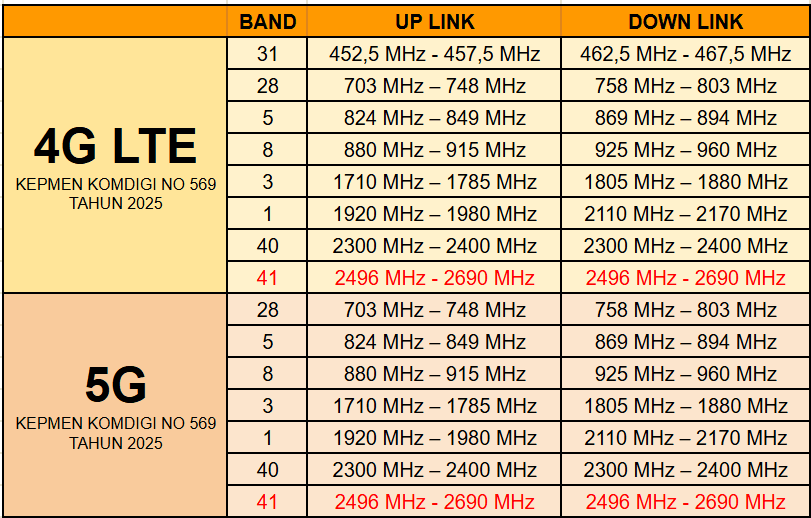
- Band 41 for LTE 2496 MHz – 2690 MHz
- Band n41 for 5G NR 2496 MHz – 2690 MHz
These bands provide additional spectrum capacity, enabling higher data throughput and improved service quality for end users.
2. List of permitted 4G and 5G frequencies in Indonesia
3. Bandwidth Expansion
With the inclusion of new frequency bands, devices can now utilize wider bandwidth, resulting in:
- Faster data transmission speeds
- More stable network connections
- Enhanced user experience
4. Updated Technical Testing Parameters
DJID Regulation 569 also updates technical requirements related to:
- Radio frequency transmission and emission limits
- Spectrum efficiency
- Safety and electromagnetic compatibility (EMC)
These changes directly affect laboratory testing procedures and DJID certification requirements.
Impact on Manufacturers and Importers
For manufacturers, brand owners, and importers of telecommunication devices, this regulation brings several important implications:
- Devices enabling Band 41 or n41 must comply with DJID Regulation 569
- Existing DJID certifications based on Regulation 352 may require reassessment if technical specifications change
- Testing must follow the updated technical standards
However, existing test reports may still be used, provided the device specifications remain compliant with the new regulation.
How Cerapproval Supports DJID Certification Under the New Regulation
As a trusted certification and product compliance agency, Cerapproval assists clients in navigating the transition from DJID Regulation 352 to DJID Regulation 569 of 2025 by providing:
- Regulatory assessment of device specifications
- Certification strategy aligned with new frequency and bandwidth requirements
- Coordination with accredited testing laboratories
- End-to-end DJID certification management
Our expertise ensures a smooth, efficient, and fully compliant certification process for entering the Indonesian market.
Conclusion
DJID Regulation No. 569 of 2025 marks an important update to Indonesia’s telecommunication standards, particularly through the expansion of frequency bands and bandwidth for LTE and 5G devices. Understanding and complying with this regulation is essential for companies seeking successful DJID certification and market access in Indonesia.
Want your device certified quickly and accurately?
Contact Cerapproval today for a free consultation and start your certification process!
- Get a free consultation for your certification.
- Download the complete guide to the KOMDIGI certification process.
- Schedule a meeting with the Cerapproval expert team today!
Contact Us Today:
🌐 www.cerapproval.com
📧 gma@cerapproval.com
📱 WhatsApp: +62 899‑3300‑033