Required Documents for SNI Certification in Indonesia

Required Documents for SNI Certification in Indonesia

Under Law No. 20 of 2024 concerning Standardization and Conformity Assessment, obtaining the SNI (Indonesian National Standard) Certificate requires specific documentation. As a leading certification agency, Cerapproval provides a detailed checklist to ensure applicants are fully prepared. In this guide, we cover both essential and supplementary documents needed for successful SNI certification.

[…]
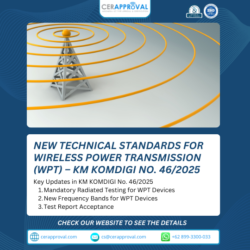
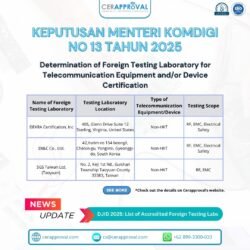
image new technical standards for wireless power transmission

New Technical Standards for Wireless Power Transmission (WPT) – KM KOMDIGI No. 46/2025

The Indonesian Ministry of Communication and Digital (KOMDIGI) has officially issued Ministerial Decree (KM) No. 46 of 2025, which establishes new technical standards for Wireless Power Transmission (WPT) devices.

Recognition of Foreign Test Labs for Indonesia DJID/SDPPI Certification – KEPMEN KOMDIGI No.13 Tahun 2025

Recognition of Foreign Test Labs for Indonesia DJID/SDPPI Certification – KEPMEN KOMDIGI No.13 Tahun 2025

The Indonesian government, through the Ministry of Communication and Digital (KOMDIGI), has issued the Ministerial Decree KOMDIGI No. 13 Year 2025 concerning the Recognition of Foreign Test Laboratories for Certification of Telecommunication Devices and/or Equipment.

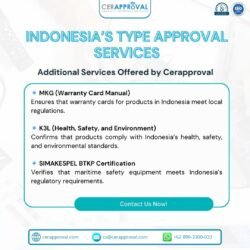
Indonesia Type Approval with Cerapproval – DJID / SDPPI, SNI, TKDN, K3L, MKG, & SIMAKESPEL Certification

Get Indonesia Type Approval with Cerapproval – DJID / SDPPI, SNI, TKDN, K3L, MKG, & SIMAKESPEL Certification

Cerapproval provides Indonesia’s Type Approval services, including DJID / SDPPI Certification issued by the Ministry of Communication and Digital Affairs (KOMDIGI) and SNI Certification Type Approval by the Ministry of Industry (KEMENPERIN).

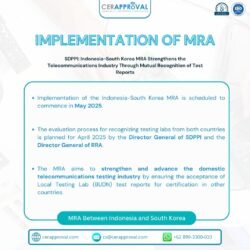
SDPPI: Indonesia-South Korea MRA Strengthens the Telecommunications Industry Through Mutual Recognition of Test Reports

SDPPI: Indonesia-South Korea MRA Strengthens the Telecommunications Industry Through Mutual Recognition of Test Reports

The rapid digital transformation in Indonesia has led to the emergence of various telecommunications devices in the market. To simplify processes and advance the domestic telecommunications industry, the Ministry of Communication and Informatics (Kominfo), through the Directorate General of Resources and Equipment of Post and Informatics (Ditjen SDPPI), is collaborating with South Korea’s Ministry of Science and ICT (MSIT) to establish mutual recognition of telecommunications device test results. Advancing the Mutual Recognition Arrangement (MRA) Between Indonesia and South Korea From September 23 to 27, 2024, the Directorate of PPI Standardization conducted a working visit to Seoul. The visit focused on follow-up meetings with South Korea’s National Radio Research Agency (RRA) to discuss strategic steps toward implementing the Indonesia-South Korea MRA, which is scheduled to commence in May 2025. The meetings were led by Mulyadi, Director of PPI Standardization, and supported by key figures, including Nur Akbar Said (Head of Cooperation on Standards and IMEI Management), Umar Wicaksono (MRA Coordinator), Hetty (Coordinator for Foreign Test Lab Recognition), and Fery Andriyanto (IMEI Management Coordinator). Key Goals of the MRA Agreement Mulyadi explained that the MRA aims to recognize Foreign Testing Labs (BULN) and their test reports. “This initiative seeks to strengthen and advance the domestic telecommunications testing industry by ensuring the acceptance of Local Testing Lab (BUDN) test reports for certification in other countries. It also aims to create equivalence in testing capabilities between BUDN and BULN,” said Mulyadi on Wednesday, September 25, 2024. Confidence Building and Knowledge Sharing One of the essential steps toward MRA implementation is building mutual confidence between Indonesia and South Korea. This involves sharing information about technical standards, regulations, policies, and conducting comparison tests between the two countries. This collaboration follows the Letter of Intent signed by the Director General of SDPPI and the Director General of RRA in Bali on March 7, 2024. Additionally, the Phase I MRA Agreement for recognizing BULN and test reports for telecommunications device certification was signed in Jakarta on May 27, 2024, by Indonesia’s Vice Minister of Kominfo and South Korea’s Vice Minister of MSIT. Upcoming Training and Workshops During the meeting with RRA, both parties reviewed and discussed the draft training and knowledge-sharing programs. It was agreed that online training sessions will take place by the end of 2024, followed by in-person workshops in 2025. “These programs are expected to enhance understanding and skills related to the testing standards required by each country. Furthermore, they aim to ensure testing quality through inter-laboratory comparison tests and Post-Market Surveillance activities,” Mulyadi added. Timeline for Testing Lab Evaluation The evaluation process for recognizing testing labs from both countries is planned for April 2025. The final approval will be granted by the Director General of SDPPI and the Director General of RRA. This collaboration is anticipated to not only benefit the telecommunications industries of both countries but also pave the way for smoother certification processes, improved testing standards, and stronger bilateral ties in the field of digital innovation.

Addition of Frequency Bands for LTE and 5G in Indonesia

Addition of Bands for LTE and 5G in the New Regulation Kepmen Kominfo No. 352 of 2024

The Minister of Communication and Information Technology of the Republic of Indonesia, Budi Arie Setiadi, has enacted the Ministerial Decree No. 352 of 2024. This regulation governs the technical standards for telecommunications devices and/or mobile telecommunication devices based on Long Term Evolution (LTE) and International Mobile Telecommunications-2020 (5G) technology standards.