TelecomCompliance

SDPPI / DJID

SDPPI Certification for Smart Dashcams and GPS Trackers

Smart dashcams and vehicle GPS trackers help businesses improve road safety, monitor vehicles, and manage fleets. However, companies that import these devices into Indonesia must check the applicable telecommunications regulations before bringing them to market. SDPPI Certification for Smart Dashcams and GPS Trackers helps businesses understand the compliance steps they may need to take. The exact requirements depend on the device’s wireless functions, technical specifications, and applicable regulations. This guide explains the main considerations, documents, and steps to review before importing or selling these products in Indonesia. When Is SDPPI Certification Required? Indonesia regulates telecommunications equipment through Minister of Communication and Informatics Regulation No. 3 of 2024. The regulation sets requirements for covered equipment manufactured, assembled, or imported for trade or use in Indonesia. Therefore, businesses should confirm whether their products fall within the applicable certification requirements before import or distribution. Not every device follows the same process. Its radio technology, operating frequency, hardware configuration, and technical standards can affect the assessment. Check the exact product specifications before deciding which certification route applies. SDPPI Certification for Smart Dashcams and GPS Trackers Smart dashcams can record driving activity and provide additional features, such as wireless connectivity and remote access. These features may affect the device’s regulatory requirements. For example, some models include Wi-Fi or Bluetooth. These functions allow users to connect the dashcam to a smartphone, transfer video files, or configure device settings. 1. Check the Wireless Features First, identify every wireless function built into the dashcam. Review the operating frequencies, supported technologies, and relevant hardware modules. Next, collect the manufacturer’s technical documents. These documents help determine which technical standards and certification requirements may apply. Do not assume that two dashcams need the same approval simply because both record video. Their wireless functions and hardware configurations may differ. 2. Review the Complete Device Configuration Some dashcams use wireless modules supplied by third-party manufacturers. However, the presence of an already-certified module does not automatically establish that the complete finished product meets every applicable requirement. For this reason, review the complete device configuration. Confirm the relevant brand, model, radio functions, and supporting documents before starting the application process. SDPPI Certification for GPS Trackers Vehicle GPS trackers help businesses monitor vehicle locations and support fleet management. However, a tracker can use several technologies, and each function serves a different purpose. 1. Understand Positioning and Data Transmission Satellite positioning allows a tracker to determine its location. By itself, this function does not explain how the device sends that information to another system. Many trackers also use cellular connectivity, such as GSM or LTE, to transmit location data to a monitoring platform. Other models may include Bluetooth, Wi-Fi, or additional radio functions. As a result, businesses should review both the positioning technology and the communication functions. This distinction helps identify the technical information needed for a regulatory assessment. 2. Confirm the Requirements for the Exact Model Before importing a GPS tracker, collect its technical specifications and identify all supported radio technologies. Then confirm which certification requirements apply to the complete product. Do not rely only on a product description or a list of supported networks. The actual hardware configuration and applicable technical standards also matter. What About Non-Wireless Dashcams and GPS Receivers? A device without Wi-Fi, Bluetooth, or cellular connectivity may have a different regulatory profile from a wireless model. However, the absence of these features does not automatically establish an exemption from every applicable requirement. Businesses should review the product’s complete functions and intended use before making a compliance decision. The safest approach is to assess each model individually. This helps importers avoid unsupported assumptions about whether certification is required. Why Telecommunications Compliance Matters A clear compliance plan helps businesses prepare for import and market entry. It also helps teams identify missing documents before they submit an application. Here are several practical benefits. Reduce Radio Interference Risks Wireless devices must meet the technical requirements that apply to their radio functions. These requirements help manage radio use and reduce the risk of harmful interference. Prepare Import Documents Earlier A review before shipment gives importers time to check product specifications, company documents, and certification requirements. Consequently, they can address missing information before it delays their plans. Avoid Unsupported Compliance Assumptions A supplier’s statement that a product is approved in another country does not, by itself, confirm compliance with Indonesian requirements. Likewise, a test report or module certificate may not cover every requirement for the finished product. Importers should verify the documents and approval route that apply to their exact model. Plan Market Entry More Clearly A defined compliance process helps teams estimate the work involved in bringing a product to market. However, certification does not guarantee that customs will release every shipment without further checks. Importers must still meet other applicable import and trade requirements. Documents to Prepare for SDPPI Certification The required documents depend on the product and its certification route. Nevertheless, businesses can start by collecting the following information. Product information: brand, model, product description, and intended use. Technical specifications: operating frequencies, wireless technologies, and relevant radio parameters. Hardware documentation: radio module details, technical diagrams, and other supporting documents available from the manufacturer. Test documentation: existing test reports and relevant technical evidence, where applicable. Company and application documents: business details and supporting records required for the applicable application process. Product labels and manuals: current product markings, user instructions, and other materials requested during the assessment. This list is a preparation guide, not a universal list of mandatory documents. Confirm the exact requirements before submitting an application. How Does the SDPPI Certification Process Work? The process depends on the product classification and applicable technical standards. In general, businesses can use the following steps to prepare. Step 1: Review the Product Start by identifying the brand, model, wireless functions, operating frequencies, and hardware configuration. This review helps establish the technical information needed for the next stage. Step 2: Confirm the Applicable Requirements Next, determine which technical standards and certification route apply to the product. If the […]

SDPPI / DJID

Complete Guide to Postel Certification for Gateway Devices in Indonesia

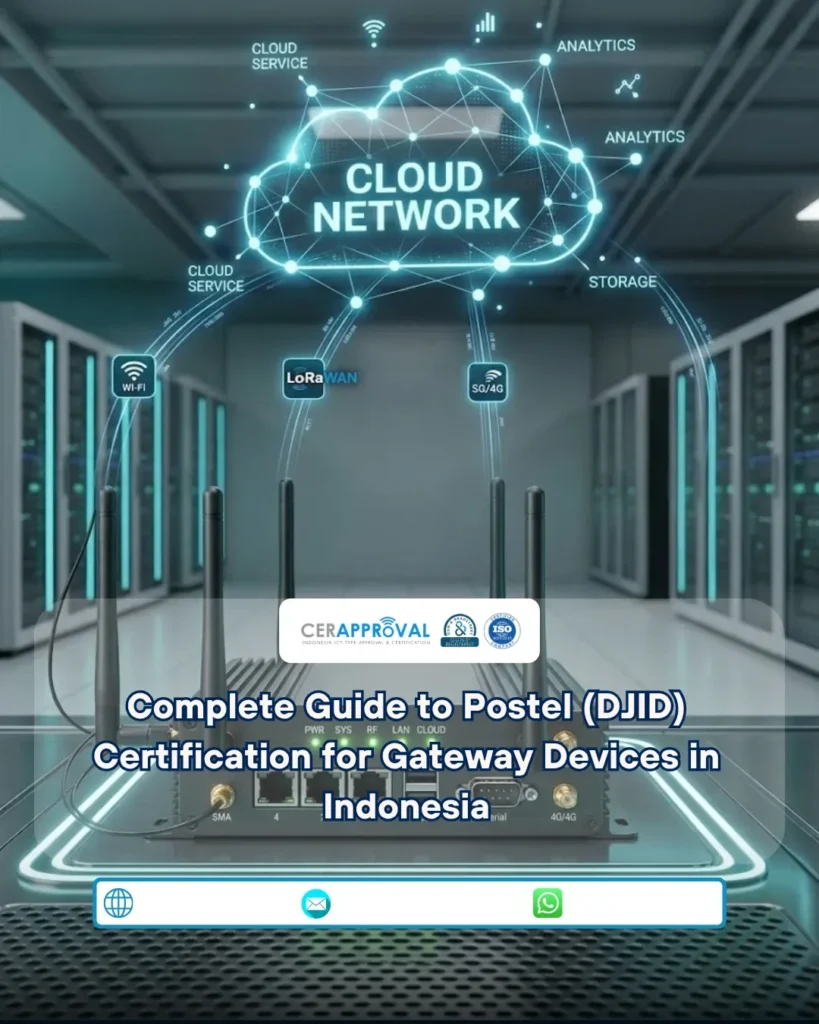
As industrial automation and IoT expand across Indonesia, gateway devices have become vital hardware infrastructure. In particular, whether deploying industrial hubs or cellular routers, these devices bridge local sensors and cloud platforms. However, distributing or importing wireless networking equipment requires strict compliance with national standards. Therefore, obtaining mandatory SDPPI certification for gateway devices is a critical regulatory milestone. Why Postel Certification for Gateway Devices Is Mandatory In Indonesia, telecommunications equipment approval is regulated by DJID under Komdigi. Consequently, modern gateways incorporating radio frequency (RF) technology must comply with strict rules. These RF technologies include: Wi-Fi (2.4 GHz / 5 GHz / Wi-Fi 6) Bluetooth / BLE Cellular Connectivity (4G LTE / 5G) LoRa / Zigbee / Sub-1GHz protocols Because gateways utilize radio frequency spectrums to transmit data, they are legally classified as Telecommunication Equipment. Thus, securing an official SDPPI certification for gateway devices is mandatory prior to commercial distribution. Key Benefits of Obtaining SDPPI Certification for Gateway Devices Achieving compliance for your SDPPI certification for gateway devices secures business continuity and market entry: Hassle-Free Customs Clearance: An official certificate is required by Indonesian Customs to release shipments. Spectrum Non-Interference: This ensures RF output power aligns strictly with national spectrum rules. Legal Eligibility: As a result, it protects distributors from severe penalties, administrative fines, or product seizures. Step-by-Step SDPPI Certification Process for Gateway Devices Securing Postel approval for gateway hardware involves a structured technical procedure: Technical Dossier Preparation: First, the applicant gathers corporate legal documents alongside technical dossiers. Consequently, you must include radio specifications, circuit schematics, and Bahasa Indonesia manuals. Laboratory Sample Testing: Next, device samples undergo RF and EMC evaluations at accredited domestic laboratories. Submission via E-Certification Portal: Afterward, compliant test reports are uploaded onto the official DJID online portal. SPH Fee Payment: Once technical compliance is validated, SDPPI issues a formal Payment Order (SPH). Mandatory Product Labeling: Finally, the applicant must place the official compliance label and QR code onto the physical gateway device. Streamline Your SDPPI Certification for Gateway Devices with Cerapproval Navigating multi-frequency certifications for advanced gateways requires deep regulatory knowledge. However, Cerapproval offers end-to-end management for your SDPPI certification for gateway devices. Furthermore, you can explore our detailed guide on SDPPI certification for smart massage chairs to learn more about RF device compliance. Additionally, check our Mandatory SNI Certification Services and TKDN Local Content Requirements to streamline your imports. Do you want your device certified quickly and accurately? You can ensure smooth market entry for your products today. Get Started with Cerapproval Today Contact Cerapproval today for a free consultation and start your compliance process! Reach out to us to schedule a free certification consultation. Download the complete guide to the KOMDIGI regulatory framework. Schedule a meeting with the Cerapproval expert team today! Read more: SDPPI Certification for Smart Massage Chairs Contact Us Today: 🌐 Website: www.cerapproval.com 📧 Email: gma@cerapproval.com 📱 WhatsApp: +62 899-3300-033

SDPPI / DJID

Does a Heart Rate Sensor Need Postel (SDPPI) Certification in Indonesia

SDPPI certification for heart rate sensor devices is mandatory for makers and importers entering Indonesia. Furthermore, the smart health and fitness market in Indonesia is growing fast. However, companies must follow national telecom rules before launching wireless tools. Basically, heart rate sensors come in chest straps, smart bands, and gym equipment. The short answer is simple. If your sensor uses wireless signals, you need Postel approval before selling it. 1. Understanding SDPPI Certification For Heart Rate Sensor First, Komdigi issues official SDPPI certificates through the Directorate General of Digital Infrastructure. Therefore, SDPPI certification for heart rate sensor tools ensures that radio frequency devices meet technical standards. In addition, modern sensors transmit real-time data using radio modules. For example, devices use these common wireless types: Bluetooth Low Energy (BLE) ANT+ Wi-Fi Cellular / IoT modules Because these tools emit radio waves, they count as telecommunication equipment. Consequently, importers strictly need approval. However, purely wired sensors without radio modules do not need SDPPI certification. 2. Why Compliance Matters for Heart Rate Sensors Indeed, getting approval provides big legal and business benefits. Importers must secure certification for three main reasons: Customs Clearance: Indonesian Customs requires a valid SDPPI certificate to release imported goods. Spectrum Safety: Testing confirms that 2.4 GHz frequencies do not block national communication lines. Legal Eligibility: Official papers protect your business from product bans and heavy legal fines. 3. Step-by-Step SDPPI Certification Process Obtaining approval follows a simple, structured workflow: First, prepare technical dossiers: Collect local business IDs (NIB), radio specs, circuit charts, and Indonesian manuals. Next, start laboratory testing: Send device samples to accredited labs for Radio Frequency (RF) and EMC tests. Then, submit online files: Upload compliant test reports to the official SDPPI web portal. Subsequently, pay government fees: Settle the official SPH bill after evaluators approve your documents. Finally, affix product labels: Print the official SDPPI compliance label and QR code on retail boxes. Streamline Compliance with Cerapproval Handling radio frequency rules for health gear can feel hard. However, Cerapproval offers simple end-to-end help for your brand. Specifically, we manage lab testing, document checks, and government filings for global medical and fitness brands. Do you need fast help to get SDPPI certification for heart rate sensor products? Contact Cerapproval today for a free advice session to start your process! Get a free consultation for your certification. Download the complete guide to the KOMDIGI certification process. Schedule a meeting with the Cerapproval expert team today! Contact Us Today: 🌐 www.cerapproval.com 📧 gma@cerapproval.com 📱 WhatsApp: +62 899‑3300‑033

SDPPI / DJID

SDPPI Certification for Home Appliances in Indonesia: Complete Guide

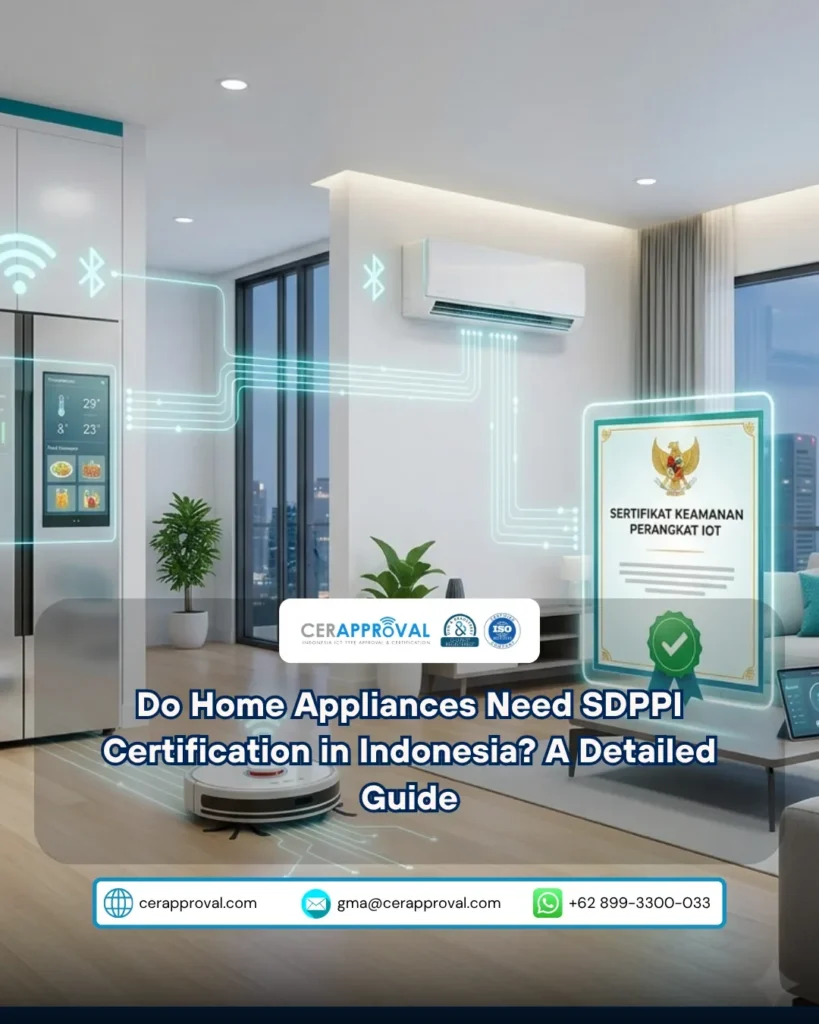
Berikut adalah hasil analisis dan draf artikel hasil optimasi penuh untuk artikel SDPPI Certification for Home Appliances ini. Gue menargetkan Focus Keyphrase: “SDPPI certification for home appliances” dengan standar penuh SEO (100 poin) dan Readability (100 poin) untuk backend regex Bahasa Inggris lu! (Catatan: Paragraf akhir yang terdapat typo templat “EV Charger” sudah gue bersihkan dan fokuskan kembali penuh ke Home Appliances). Hasil Analisis & Audit Utama SEO Title & Slug: Judul awal belum berfokus pada keyword utama di depan. Perbaikan: Dibuat 54 karakter dengan keyword utama berada persis di awal judul. Meta Description: Belum ada meta description bawaan. Perbaikan: Dibuat 142 karakter lengkap dengan keyword dan CTA mengundang klik. Density & Placement Keyword: Keyword disebar merata pada 100 kata pertama, Subheading (H2 & H3), isi paragraf (density ~1.3%), dan Alt Text gambar. Readability & Transitions: Semua kalimat pasif diubah ke kalimat aktif (is required → requires), kalimat dipotong pendek (maksimal 10–15 kata), dan disisipi English Transition Words lengkap (furthermore, however, first, therefore, next, finally, as a result) agar skor Readability otomatis hijau 85–100. Data Teknis SEO Article Focus Keyphrase: SDPPI certification for home appliances SEO Title: SDPPI Certification for Home Appliances Guide (54 karakter) Slug: sdppi-certification-for-home-appliances-guide Meta Description: Learn how to get SDPPI certification for home appliances in Indonesia. Read our step-by-step smart device approval guide now! (142 karakter) Image Alt Text: SDPPI certification for home appliances process in Indonesia Draft Artikel Hasil Optimasi (Ready to Publish) SDPPI Certification for Home Appliances Guide SDPPI certification for home appliances is mandatory for makers and importers entering the Indonesian market. Furthermore, smart appliances with IoT features are growing fast in Indonesia. However, companies must follow national telecom rules before launching wireless tools. Basically, appliances now feature smart radio controls. The short answer is simple. If your home appliance uses wireless signals, you need Postel approval before selling it. 1. When Approval Is Required First, Komdigi enforces strict rules based on device connectivity features. Therefore, SDPPI certification for home appliances applies to two main categories: Smart Home Devices (Wireless): MANDATORY. Appliances using Wi-Fi, Bluetooth, or Zigbee act as radio gear. For example, smart air conditioners, app-controlled robot vacuums, and IoT fridges need official approval. Conventional Home Devices (Non-Wireless): NOT Required. Purely electric tools without radio modules do not need SDPPI certification. However, makers must still meet national SNI or K3L safety rules. 2. Why SDPPI Certification Matters Indeed, securing approval protects your business and guarantees network safety. Importers must get certified for three main reasons: Interference Prevention: Testing ensures radio waves do not block public communication networks. Operational Safety: Audits check that power levels meet national safety limits for home use. Smooth Importation: Valid certificates allow shipments to pass Indonesian Customs without delays or seizures. 3. Step-by-Step SDPPI Certification Process Obtaining approval follows a clear, structured workflow: First, prepare technical files: Gather radio module specs, circuit charts, and Bahasa Indonesia manuals. Next, start laboratory testing: Send device samples to accredited labs for Radio Frequency (RF) and EMC tests. Then, submit online files: Upload compliant test reports to the official SDPPI web portal. Subsequently, pay government fees: Settle the official SPH bill after evaluators approve your documents. Finally, print compliance labels: Print the official SDPPI logo and QR code on retail boxes. Streamline Compliance with Cerapproval Handling radio frequency rules for smart hardware can feel hard. However, Cerapproval offers simple end-to-end help for your brand. Specifically, we manage lab testing, document evaluation, and government filings for global smart home brands. Do you need fast help to get SDPPI certification for home appliances? Contact Cerapproval today for a free advice session to start your process! Get a free consultation for your certification. Download the complete guide to the KOMDIGI certification process. Schedule a meeting with the Cerapproval expert team today! Contact Us Today: 🌐 www.cerapproval.com 📧 gma@cerapproval.com 📱 WhatsApp: +62 899‑3300‑033

Flag Counter
Scroll to Top