Author name: Adit

SDPPI / DJID

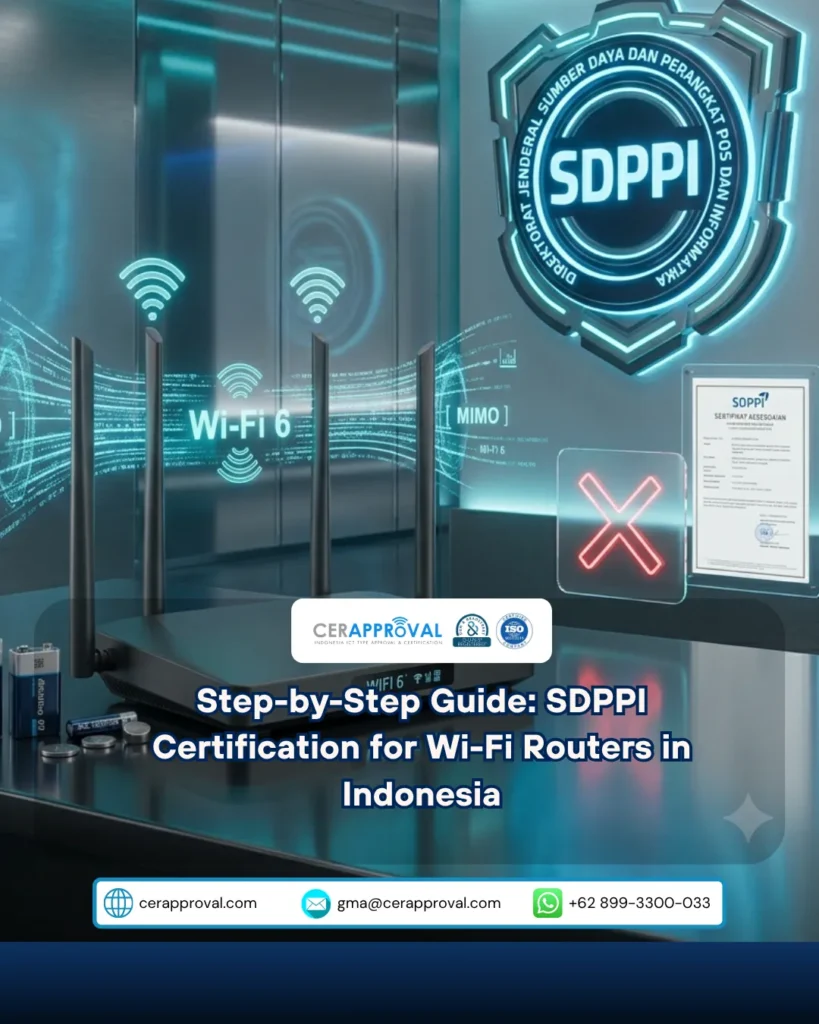
Guide to SDPPI Certification for WiFi Routers

Step-by-Step Guide: SDPPI Certification for Wi-Fi Routers in Indonesia The demand for high-speed internet and reliable home networking has driven a massive surge in the usage of Wi-Fi routers across Indonesia. Whether launching dual-band routers, Wi-Fi 6, or mesh networking equipment, foreign manufacturers and local importers must navigate Indonesia’s strict telecommunication compliance requirements before introducing these devices to the market. However, before Wi-Fi routers can be legally imported, distributed, or sold in the Indonesian market, there is one crucial regulatory step that must be completed: SDPPI certification from the Directorate General of Digital Infrastructure (DJID) of the Ministry of Communication and Digital Affairs (Komdigi).    Why SDPPI Certification is Mandatory for Wi-Fi Routers Wi-Fi routers emit radio frequency (RF) waves, utilizing unlicensed frequency bands such as 2.4 GHz, 5 GHz, and the newer 6 GHz spectrums. To prevent network pollution and ensure public safety, the Indonesian government enforces mandatory compliance testing. Key reasons for securing SDPPI certification include: Frequency Alignment: Ensuring the router’s transmission power (EIRP) and operating channels conform to Indonesian spectrum allocation rules. Interference Prevention: Guaranteeing the device does not interfere with critical cellular or national communication networks. Customs Release: Uncertified routers are blocked at Indonesian customs and cannot be cleared for local distribution. Selling uncertified Wi-Fi equipment in Indonesia is illegal and subject to severe administrative penalties, product confiscations, and legal enforcement.   The Certification Process for Wi-Fi Routers 1. Dossier Preparation and Regulatory Analysis The applicant prepares corporate legal licenses along with detailed technical dossiers. Required technical files include circuit schematics, block diagrams, technical specifications, Bahasa Indonesia user manuals, and existing international test reports (CE/FCC).   2. Sample Testing Phase Sample units must be submitted to an accredited testing laboratory recognized by SDPPI. Testing evaluates RF output power, spurious emissions, Electromagnetic Compatibility (EMC), and electrical safety parameters.   3. Portal Submission & Evaluation Test reports and technical files are submitted to the official SDPPI online portal. Government evaluators perform a comprehensive review to verify compliance against national technical standards for short-range wireless devices.   4. Fee Payment (SPH Issued) Upon successful technical evaluation, SDPPI issues a formal Payment Order (SPH). The applicant must pay the government non-tax state revenue fee within the given deadline.   5. Certificate Issuance and Labeling Once payment is confirmed, the official SDPPI certificate is generated. The applicant must then apply the required SDPPI compliance label and QR code onto the physical router and its retail packaging prior to market placement.   Streamline Your Wi-Fi Router Certification with Cerapproval Navigating local RF regulations, laboratory schedules, and government paperwork can present significant market entry hurdles. Cerapproval provides comprehensive regulatory compliance services to help businesses obtain SDPPI certification for Wi-Fi routers smoothly, quickly, and professionally. Contact Cerapproval today for a free consultation and start your certification process! Get a free consultation for your certification. Download the complete guide to the KOMDIGI certification process. Schedule a meeting with the Cerapproval expert team today!   Contact Us Today: 🌐 www.cerapproval.com 📧 gma@cerapproval.com 📱 WhatsApp: +62 899‑3300‑033
SNI

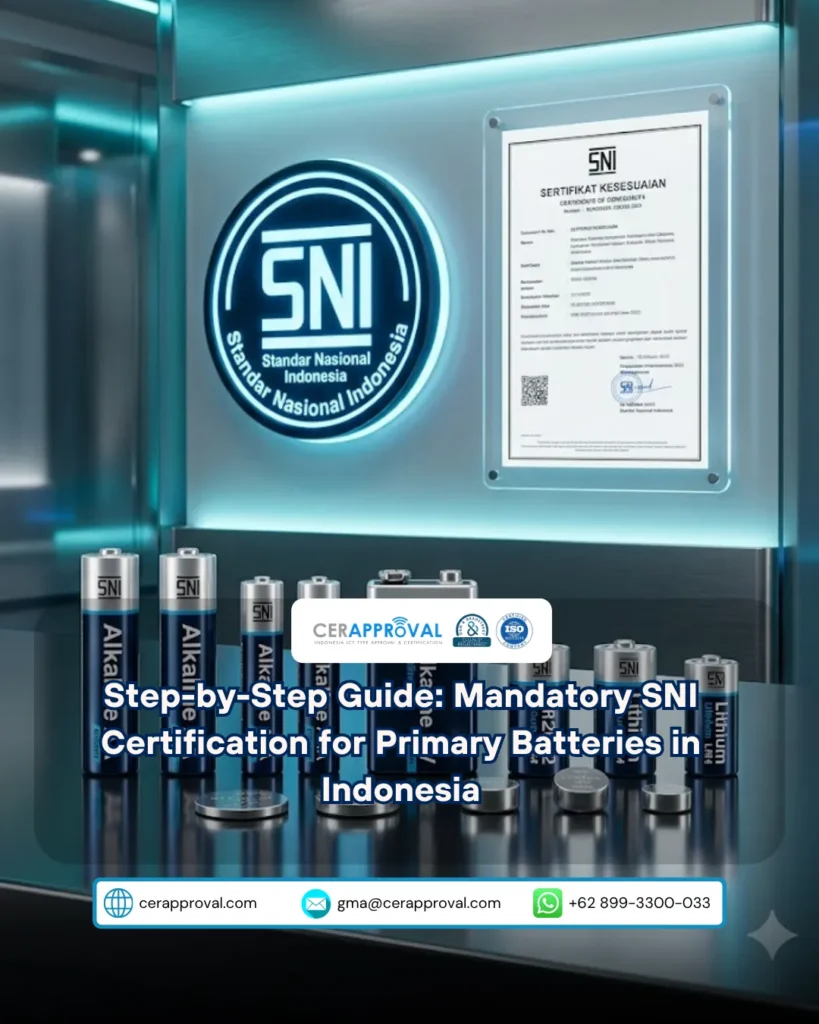
Step-by-Step Guide: Mandatory SNI Certification for Primary Batteries in Indonesia

Step-by-Step Guide: Mandatory SNI Certification for Primary Batteries in Indonesia   Primary batteries (non-rechargeable batteries such as AA, AAA, C, D, and button cells) are ubiquitous power sources utilized across millions of consumer electronics, toys, remote controls, and medical tools. Because of their high consumption rate and heavy reliance in everyday life, ensuring battery safety and quality is a top priority for Indonesian regulators.   To safeguard consumers from hazardous sub-standard products, the Indonesian government mandates that all primary batteries distributed or imported into the country must obtain the Indonesian National Standard (SNI) certification.   The Critical Importance of Mandatory SNI for Primary Batteries Chemical compounds inside primary batteries pose inherent risks if manufactured without strict quality controls. Electrolyte leakage, thermal runaway, and heavy metal contamination are significant hazards that national standards aim to prevent.   Under the relevant national standards (aligned with the SNI IEC 60086 series), SNI certification verifies that: Electrical & Physical Safety: The battery is engineered to resist short circuits, high temperatures, shock, and leakage during usage or storage. Environmental Compliance: Toxic chemical content, particularly Mercury (Hg) and Cadmium (Cd), remains strictly within legally permissible limits. Performance Integrity: The nominal voltage and discharge performance accurately match the technical specifications listed on the packaging.   Distributing or selling primary batteries without a valid SPPT-SNI (Certificate for Using the SNI Mark) constitutes a violation of Indonesian trade laws, leading to product recalls, heavy fines, or customs blockage.   The SNI Certification Process for Primary Batteries Achieving SNI compliance involves a rigorous evaluation mechanism carried out by an accredited Product Certification Body (LSPro). Below is the core workflow:   1. Application Submission & Gap Analysis The applicant (local manufacturer or authorized local representative for overseas principal) submits corporate legal permits along with technical dossiers, including battery chemistry specs, production flowcharts, and ISO 9001 certifications.   2. On-Site Manufacturing Audit Auditors from an accredited LSPro visit the manufacturing plant (domestic or international) to conduct an evaluation of the Quality Management System, factory quality control procedures, and raw material handling.   3. Sample Extraction and Laboratory Testing During the plant audit, official auditors seal random samples of primary batteries. These samples are shipped to an accredited testing laboratory to undergo stringent tests, including discharge testing, leakage resistance, climate exposure, and chemical analysis.   4. Panel Review & Certificate Issuance The technical committee reviews the audit report and laboratory test results. Upon full compliance with the primary battery SNI standard, the LSPro issues the official SPPT-SNI certificate. The manufacturer must then affix the official SNI mark and registration details onto the battery units or retail packaging.   Streamline Your Battery Certification with Cerapproval Navigating complex technical standards, laboratory coordination, and regulatory compliance can be demanding for both local distributors and foreign manufacturers. Cerapproval acts as your dedicated compliance partner in Indonesia, facilitating the entire SNI certification process for your primary battery products efficiently from start to finish.   Contact Cerapproval today for a free consultation and start your certification process! Get a free consultation for your certification. Download the complete guide to the KOMDIGI certification process. Schedule a meeting with the Cerapproval expert team today!   Contact Us Today: 🌐 www.cerapproval.com 📧 gma@cerapproval.com 📱 WhatsApp: +62 899‑3300‑033
SDPPI / DJID

Product Certification Guide for Foreign Companies

Step-by-Step Guide: Product Certification Workflow in Indonesia for Foreign Companies   Indonesia presents an incredible market opportunity for global brands, driven by its massive population and booming economy. Whether manufacturing consumer electronics, wireless telecommunications equipment, industrial goods, or health products, international companies are continuously looking to expand their distribution footprint into the Indonesian market.   However, entry into the Indonesian domestic market requires strict compliance with local regulatory frameworks. The Indonesian government enforces mandatory certifications—such as SDPPI for wireless devices, SNI for quality standards, K3L for safety, and BPOM/Halal for consumables. Navigating the legal compliance process as a foreign entity can be challenging without a clear understanding of the regulatory workflow.   Key Compliance Challenges for Foreign Manufacturers Foreign companies without a physical legal presence or branch office in Indonesia face unique hurdles during the certification process: Mandatory Local Holder Requirement: Most regulatory bodies in Indonesia require the certificate applicant or holder to be a registered local legal entity possessing a Business Identification Number (NIB). Localization & Language Compliance: Technical documentation, product labels, and user manuals must often be translated into Bahasa Indonesia and conform to specific local templates. In-Country Testing & Overseas Audits: Certain certifications mandate testing inside Indonesian accredited laboratories or require local auditors to travel overseas for manufacturing plant audits.   The Certification Process for Foreign Entities 1. Appointing a Local Representative or Partner Since overseas manufacturers usually cannot apply directly, foreign companies must appoint a local distributor or engage an experienced regulatory agency like Cerapproval to act as their local representative and handle the certification process on their behalf.   2. Identifying Applicable Regulatory Schemes Determining the exact mandatory certifications required for the product type is essential: Wireless, Bluetooth, or Telecom devices require SDPPI Certification. Specific manufactured and raw goods fall under SNI (Indonesian National Standard). Electronic appliances for safety and health require K3L Registration.   3. Initial Technical Document Gap Analysis The technical dossier provided by the foreign principal—such as existing international test reports (CE, FCC, CB scheme), circuit schematics, block diagrams, and manuals—is thoroughly reviewed to ensure it meets Indonesian national standards.   4. Laboratory Testing Phase Depending on the regulatory pathway: In-Country Testing: Sample units are shipped to Indonesia to undergo laboratory testing at a KAN-accredited testing facility. Paperwork/MRA Recognition: For specific regulations like SDPPI, test reports generated by recognized foreign MRA (Mutual Recognition Agreement) laboratories can be accepted directly, eliminating the need for local testing.   5. Overseas Factory Audit (When Applicable) For certifications such as mandatory SNI, appointed auditors from an official Indonesian Product Certification Body (LSPro) will conduct an on-site audit at the foreign manufacturing plant to verify Quality Management System (ISO 9001) compliance.   6. Evaluation & Certificate Issuance Upon passing technical reviews and laboratory tests, the government authority or certification body issues the official certificate. The foreign manufacturer or local importer must then apply the required compliance marks and registration numbers onto the product packaging before commercial distribution.   Streamline Your Market Access with Cerapproval Overcoming regulatory hurdles, language barriers, and time zone differences is much easier with a trusted local compliance partner. Cerapproval specializes in providing end-to-end certification services for foreign companies aiming to enter the Indonesian market. From document gap analysis to local representation and certificate issuance, Cerapproval ensures a smooth, fast, and fully compliant market entry.   Contact Cerapproval today for a free consultation and start your certification process! Get a free consultation for your certification. Download the complete guide to the KOMDIGI certification process. Schedule a meeting with the Cerapproval expert team today!   Contact Us Today: 🌐 www.cerapproval.com 📧 gma@cerapproval.com 📱 WhatsApp: +62 899‑3300‑033
SDPPI / DJID

Why RF Devices Get Held by Customs: SDPPI / DJID Certification Guide

Have you ever imported electronic equipment such as Wi-Fi routers, Bluetooth modules, IoT gateways, or wireless devices, only to find them held at Indonesian Customs? Detainment of Radio Frequency (RF) devices is a frequent challenge faced by global manufacturers, importers, and distributors entering the Indonesian market. Understanding the regulatory requirements is crucial to avoiding costly port storage fees and shipment rejections. Why Are Radio Frequency Devices Held by Indonesian Customs? The primary reason Customs detains RF equipment is the lack of mandatory Type Approval certification. Under Indonesian law, the use of radio frequency spectrums is strictly regulated by the Ministry of Communication and Digital (Komdigi) through the Directorate General of Digital Infrastructure (DJID) — formerly known as Ditjen SDPPI. Key causes for customs detention include: Missing SDPPI / DJID Certificate: Any device utilizing RF technology (Wi-Fi, Bluetooth, Cellular 4G/5G, RFID, Radar) must obtain official certification before entering Indonesian territory. Absence of Official Certification Labeling: Even if your product holds global compliance marks (FCC, CE, Anatel), it still requires local registry and placement of the official DJID QR code label. Non-Compliant Frequency Bands: Devices operating on frequency bands reserved for emergency services or unauthorized power limits will be flagged immediately upon customs inspection. Step-by-Step Guide: How to Obtain SDPPI / DJID Certification Clearing your detained shipment or preparing for a seamless market entry requires obtaining a valid DJID Type Approval Certificate. Here is how the process works: Product Testing: Testing must be conducted at an accredited local testing laboratory (Balai Uji) in Indonesia or via paper evaluation using test reports from recognized foreign labs under MRA schemes. Documentation Preparation: Detailed technical specifications, RF block diagrams, and operational descriptions High-resolution product interior and exterior photographs Manufacturer’s ISO 9001 certificate Local entity credentials (NIB & Business License of the Indonesian Applicant/Importer) Application Submission: Submitting the test reports and technical dossiers to the official DJID digital certification portal. Fee Payment (SP2): Upon successful document evaluation, an official payment order (SP2) is issued for non-tax state revenue. Certificate Issuance & Label Compliance: Once issued, the certificate allows the product to legally pass through Customs. The importer must attach the official DJID label and QR code onto the device packaging. Fast-Track Your Approval with Cerapproval Navigating local Indonesian regulations, language barriers, and laboratory testing can significantly delay your product launch. Cerapproval is your premier regulatory compliance agency in Indonesia. We specialize in end-to-end SDPPI/DJID certification services, local representation, and customs issue resolution for international technology brands. Facing customs clearance delays for your RF devices? Avoid costly customs delays! Partner with Cerapproval today for hassle-free SDPPI/DJID compliance and fast-track clearance for all your RF devices into Indonesia.   Contact Cerapproval today for a free consultation and start your certification process! Get a free consultation for your certification. Download the complete guide to the KOMDIGI certification process. Schedule a meeting with the Cerapproval expert team today! Contact Us Today: 🌐 www.cerapproval.com 📧 gma@cerapproval.com 📱 WhatsApp: +62 899‑3300‑033  
Flag Counter
Scroll to Top