Author name: Adit

SNI

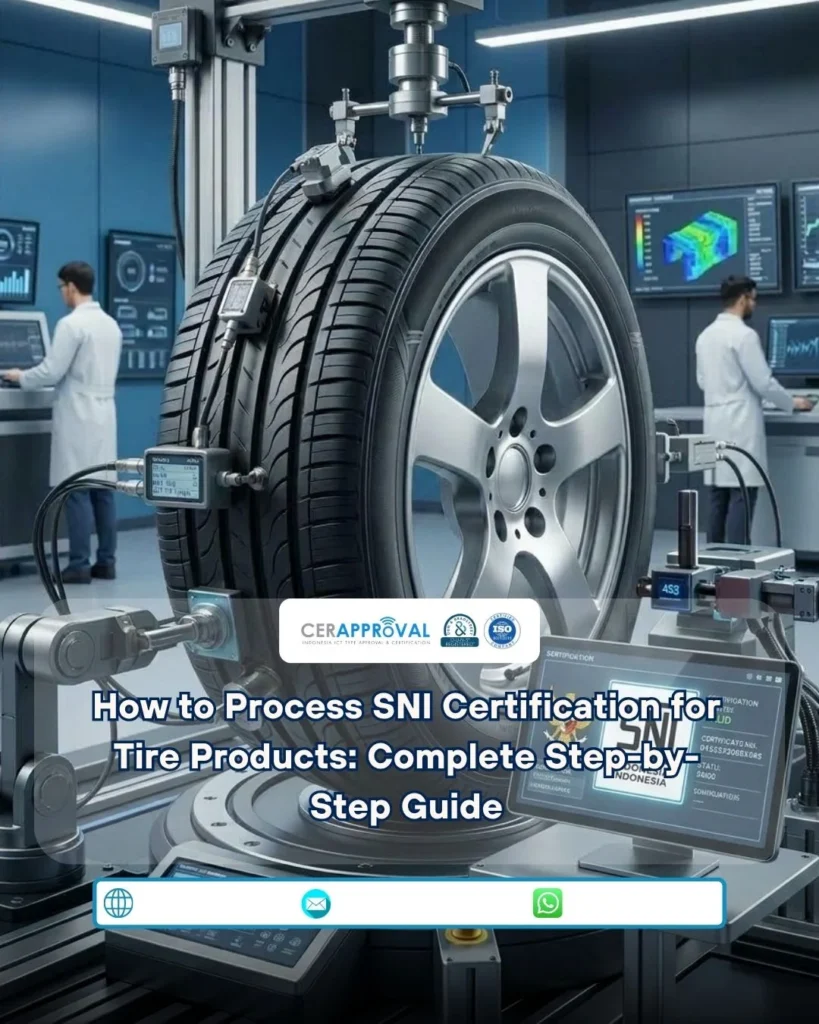
How to Process SNI Certification for Tire Products

Vehicle tires are among the most critical safety components on any motor vehicle. Because tire failures directly impact road safety and human lives, the Indonesian Government strictly mandates that all tires manufactured locally or imported into the country must obtain mandatory SNI (Standar Nasional Indonesia) certification. For automotive manufacturers, international sellers, and local importers, selling uncertified tires in Indonesia can result in severe customs detentions, product recalls, and legal penalties. Mandatory SNI Certification for Tire Products in Indonesia The Indonesian Ministry of Industry classifies mandatory SNI standards according to the vehicle application: SNI 0098: Passenger Car Tires SNI 0099: Light Truck Tires SNI 0100: Truck and Bus Tires SNI 0101: Motorcycle Tires SNI 6700: Inner Tubes for Motor Vehicle Tires Step-by-Step Guide: How to Process Mandatory SNI Certification for Tires Securing a Product Certificate for the Use of the SNI Mark (SPPT SNI) for tire products involves rigorous administrative checks, factory audits, and specialized laboratory testing. 1.Document and Technical Dossier Preparation: First, applicants must compile legal and technical documentation. Consequently, you will need to prepare your Business Identification Number (NIB), local business licenses, and the manufacturer’s ISO 9001 Quality Management System certificate. Additionally, include an Official Letter of Appointment from the overseas factory if applying via a local importer, alongside comprehensive technical datasheets covering tire sizes, load index, speed symbols, and tread pattern designs. 2.Submission to Accredited LSPro: Next, submit the application dossier to a Product Certification Body (LSPro). However, ensure that the body is accredited by KAN (National Accreditation Committee) and authorized by the Ministry of Industry. 3.On-Site Factory Audit: Afterward, qualified auditors from the LSPro conduct an on-site audit of the manufacturing facility, whether located domestically or abroad. As a result, they verify raw rubber quality controls, manufacturing processes, and overall quality assurance systems. 4.Sample Collection and Laboratory Testing: During the audit, auditors select and seal representative tire samples, which are then dispatched to an accredited testing laboratory in Indonesia. Furthermore, laboratory testing evaluates four key areas: Endurance Testing: Running the tire on high-speed testing drums under loaded conditions. High-Speed Performance Testing: Evaluating structural integrity at elevated speed ratings over specified intervals. Plunger Energy / Penetration Testing: Testing resistance against sharp object impacts and punctures. Dimensional and Bead Inspection: Verifying rim fitment precision, tread wear indicators, and physical measurements. 5.SPPT SNI Certificate Issuance: Once both the factory audit report and laboratory test reports satisfy all SNI parameters, the LSPro issues the official SPPT SNI Certificate. 6.NPB Registration and Mandatory Sidewall Marking: Finally, after receiving the SPPT SNI, the applicant registers for a Product Registration Number (NPB) with the Ministry of Trade. Therefore, the official SNI logo must be permanently embossed on the tire sidewall prior to commercial distribution. Streamline Your Regulatory Compliance with Cerapproval Navigating local testing rules and government filings requires expert guidance. Fortunately, end-to-end type approval services are offered by Cerapproval. Fast, compliant, and hassle-free market entry is achieved for your devices. Need assistance securing POSTEL / DJID certification for your products? Smooth market entry can be guaranteed for your wireless electronics! Partner with Cerapproval today for expert type approval services. Contact Cerapproval today for a free consultation and start your certification process! Get a free consultation for your certification. Download the complete guide to the KOMDIGI certification process. Schedule a meeting with the Cerapproval expert team today! Contact Us Today: 🌐 www.cerapproval.com πŸ“§ gma@cerapproval.com πŸ“± WhatsApp: +62 899‑3300‑033

SDPPI / DJID

Why Do Radio Frequency Devices Need POSTEL Certification and How Is It Processed?

The rapid proliferation of wireless technology is everywhere. Radio Frequency (RF) devices are now an integral part of modern life. Devices range from Wi-Fi routers and Bluetooth headsets to smart home hubs. Industrial IoT gateways and agricultural drones also rely on radio waves. Consequently, POSTEL Certification is managed by the Directorate General of Digital Infrastructure (DJID under Komdigi). Obtaining this certificate is mandated for international manufacturers and importers. Why Radio Frequency Devices Need POSTEL Certification and Process Guide Obtaining POSTEL certification is far more than a routine requirement. In fact, vital technical and regulatory purposes are served by this process: Preventing Harmful Frequency Interference: The radio spectrum is recognized as a finite national resource. Therefore, strict operation within authorized frequency bands is ensured by mandatory type approval. Disruption to critical networks like aviation navigation is completely prevented. Ensuring Health & Product Safety: Electromagnetic radiation levels (SAR) are thoroughly verified during certification testing. Furthermore, electrical safety standards are strictly checked. Compliance with safety thresholds is maintained to protect consumers. Indonesian Customs Clearance Compliance: Imported wireless electronics are strictly inspected by Indonesian Customs (Bea Cukai). As a result, non-certified shipments are immediately detained or slated for re-export. Market Legality and Consumer Trust: Severe legal penalties can be caused by unapproved RF equipment. Goods may be confiscated by authorities. Long-term brand damage is also risked. Step-by-Step Process to Obtain POSTEL / DJID Certification Navigating the POSTEL certification workflow involves key steps: Document Dossier Preparation: First, technical datasheets and RF block diagrams are compiled. Photos, ISO 9001 certificates, and the local NIB are also required. RF and EMC Testing: Next, testing is conducted at accredited local laboratories. Alternatively, valid international test reports are accepted under the MRA framework. Online Portal Application: Subsequently, the complete technical dossier is submitted via the official DJID online portal. Government Fee Payment (SP2): Then, non-tax state revenue (PNBP) fees are settled upon receiving the official SP2 invoice. Certificate Issuance & Mandatory Labeling: Finally, the certificate is officially issued. The DJID approval mark and QR code must be affixed onto all units and packaging. In summary, an SDPPI (Postel) certificate must be obtained for RF devices. Order in the radio spectrum is maintained. Consumers and national networks are kept protected. In contrast, significant risks are created if devices are left uncertified: Signal Interference (Radio Interference): Non-standard radio waves may be emitted by non-certified devices. Consequently, interference is caused to aviation radar, emergency communications, and cellular signals. Potential Electrical and Health Hazards: EMC and electrical safety are tested during certification. If devices are uncertified, risks of overheating are greatly increased. Dangerous radiation may also be emitted. Legal Violations & Criminal Penalties: Indonesia’s Telecommunications Law is directly violated by uncertified equipment. As a result, administrative sanctions and heavy fines are imposed on violators. Immediate confiscation of goods is also executed. Seizure by Customs / Import Rejection: Imported devices without certificates are detained at customs. Local market distribution is strictly prohibited. Streamline Your Regulatory Compliance with Cerapproval Navigating local testing rules and government filings requires expert guidance. Fortunately, end-to-end type approval services are offered by Cerapproval. Fast, compliant, and hassle-free market entry is achieved for your devices. Need assistance securing POSTEL / DJID certification for your products? Smooth market entry can be guaranteed for your wireless electronics! Partner with Cerapproval today for expert type approval services. Contact Cerapproval today for a free consultation and start your certification process! Get a free consultation for your certification. Download the complete guide to the KOMDIGI certification process. Schedule a meeting with the Cerapproval expert team today! Contact Us Today: 🌐 www.cerapproval.com πŸ“§ gma@cerapproval.com πŸ“± WhatsApp: +62 899‑3300‑033

SNI

SNI Certification for Electric Fans & Step-by-Step SDPPI/DJID Approval Guide

SNI certification for electric fans is mandatory for makers and importers entering the Indonesian market. Furthermore, selling home appliances in Indonesia offers big business opportunities. However, companies must follow clear safety and trade rules. First, basic cooling fans must meet mandatory Standar Nasional Indonesia (SNI) rules. In addition, smart models with Wi-Fi or Bluetooth need Directorate General of Digital Infrastructure (DJID/SDPPI) approval. 1. Mandatory SNI Certification for Electric Fans Basically, the Ministry of Industry sets safety rules for home devices. Therefore, SNI certification for electric fans protects users from electric shocks, broken parts, and fire risks. Key Safety Standards SNI IEC 60335-2-80 / SNI 7609: Safety rules for table, wall, stand, ceiling, and duct fans. SNI 7859 / SNI IEC 60335-1: General electric safety rules for home appliances. SNI IEC 60879: Energy efficiency standards and official SKEM labels. Step-by-Step SNI Process First, send your application to an accredited Product Certification Body (LSPro). Next, auditors inspect your factory Quality Management System (ISO 9001). Then, lab experts test sample units for safety and durability. Finally, get your SPPT SNI certificate and register a Product Number (NPB) with the Ministry of Trade. 2. How to Get SDPPI / DJID Approval for Smart Fans For example, if your fan uses Wi-Fi, Bluetooth, or remotes, it acts as a radio device. For this reason, you must get DJID Type Approval along with your SNI certification for electric fans. Step-by-Step SDPPI / DJID Process First, collect tech specs, RF charts, ISO 9001 papers, and local business IDs (NIB). Next, run tests at an approved Indonesian lab or send valid test reports. After that, upload all lab reports and legal forms to the official DJID web portal. Subsequently, pay the non-tax fee (PNBP) right after you get your SP2 bill. Finally, download your official certificate and print the DJID logo and QR code on product boxes. Streamline Compliance with Cerapproval Indeed, handling dual approvals can feel hard and slow. However, Cerapproval offers simple end-to-end help. As a result, we manage lab tests, factory checks, and government filings for top brands. Specifically, do you need fast help with your SNI certification for electric fans or SDPPI approval? Contact Cerapproval today for a free advice session to start your market entry! Website: www.cerapproval.com Email: gma@cerapproval.com WhatsApp: +62 899-3300-033

SDPPI / DJID

Does a Gamepad Require SDPPI Postel Certification in Indonesia?

SDPPI certification for gamepad is mandatory for makers and importers launching wireless controllers in Indonesia. Furthermore, the gaming hardware market in Indonesia offers big business opportunities. However, companies must follow national telecom safety rules. Basically, Postel certification is an official type approval issued by Komdigi. The short answer is simple. If your gamepad uses any form of wireless connection, you need approval before selling it. 1. Understanding SDPPI Certification For Gamepad First, Komdigi manages the SDPPI certification process under strict national laws. Therefore, SDPPI certification for gamepad ensures that radio frequency devices work safely in target frequency bands. In addition, this process prevents harmful interference with national networks. As a result, your products can pass customs smoothly and reach local buyers safely. 2. Which Gamepads Require SDPPI Approval? Whether your controller needs approval depends on its tech specs. For example, consider these two main types: Wired Gamepads: Controllers that connect only through a USB cable do not emit radio signals. Therefore, they do not need SDPPI approval. Wireless Gamepads (Bluetooth / 2.4 GHz RF / Wi-Fi): Controllers with Bluetooth or RF dongles emit radio waves. Consequently, they strictly need SDPPI certification for gamepad before import and sales. 3. Risks of Non-Compliance in Indonesia Indeed, selling uncertified wireless gamepads leads to severe legal problems. Importers should avoid these main risks: Customs Holds: Border officials detain imported shipments that lack valid certificates. E-Commerce Takedowns: Local online stores remove non-compliant wireless items quickly. Legal Penalties: Selling unauthorized radio devices breaks Indonesian telecom law. Finally, this leads to heavy fines and legal sanctions. Streamline Compliance with Cerapproval Handling local testing and Komdigi filings can feel hard and slow. However, Cerapproval offers simple end-to-end help for your brand. Specifically, we manage lab testing, document evaluation, and final approval for top hardware brands. Do you need fast help to get SDPPI certification for gamepad? Contact Cerapproval today for a free advice session to start your process! Get a free consultation for your certification. Download the complete guide to the KOMDIGI certification process. Schedule a meeting with the Cerapproval expert team today! Contact Us Today: 🌐 www.cerapproval.com πŸ“§ gma@cerapproval.com πŸ“± WhatsApp: +62 899‑3300‑033

SDPPI / DJID

Does a Heart Rate Sensor Need Postel (SDPPI) Certification in Indonesia

SDPPI certification for heart rate sensor devices is mandatory for makers and importers entering Indonesia. Furthermore, the smart health and fitness market in Indonesia is growing fast. However, companies must follow national telecom rules before launching wireless tools. Basically, heart rate sensors come in chest straps, smart bands, and gym equipment. The short answer is simple. If your sensor uses wireless signals, you need Postel approval before selling it. 1. Understanding SDPPI Certification For Heart Rate Sensor First, Komdigi issues official SDPPI certificates through the Directorate General of Digital Infrastructure. Therefore, SDPPI certification for heart rate sensor tools ensures that radio frequency devices meet technical standards. In addition, modern sensors transmit real-time data using radio modules. For example, devices use these common wireless types: Bluetooth Low Energy (BLE) ANT+ Wi-Fi Cellular / IoT modules Because these tools emit radio waves, they count as telecommunication equipment. Consequently, importers strictly need approval. However, purely wired sensors without radio modules do not need SDPPI certification. 2. Why Compliance Matters for Heart Rate Sensors Indeed, getting approval provides big legal and business benefits. Importers must secure certification for three main reasons: Customs Clearance: Indonesian Customs requires a valid SDPPI certificate to release imported goods. Spectrum Safety: Testing confirms that 2.4 GHz frequencies do not block national communication lines. Legal Eligibility: Official papers protect your business from product bans and heavy legal fines. 3. Step-by-Step SDPPI Certification Process Obtaining approval follows a simple, structured workflow: First, prepare technical dossiers: Collect local business IDs (NIB), radio specs, circuit charts, and Indonesian manuals. Next, start laboratory testing: Send device samples to accredited labs for Radio Frequency (RF) and EMC tests. Then, submit online files: Upload compliant test reports to the official SDPPI web portal. Subsequently, pay government fees: Settle the official SPH bill after evaluators approve your documents. Finally, affix product labels: Print the official SDPPI compliance label and QR code on retail boxes. Streamline Compliance with Cerapproval Handling radio frequency rules for health gear can feel hard. However, Cerapproval offers simple end-to-end help for your brand. Specifically, we manage lab testing, document checks, and government filings for global medical and fitness brands. Do you need fast help to get SDPPI certification for heart rate sensor products? Contact Cerapproval today for a free advice session to start your process! Get a free consultation for your certification. Download the complete guide to the KOMDIGI certification process. Schedule a meeting with the Cerapproval expert team today! Contact Us Today: 🌐 www.cerapproval.com πŸ“§ gma@cerapproval.com πŸ“± WhatsApp: +62 899‑3300‑033

K3L

How to Process K3L Certification for Vacuum Cleaner Devices in Indonesia?

K3L certification for vacuum cleaner products is mandatory for makers and importers entering Indonesia. Furthermore, demand for modern cleaning devices in Indonesia is growing fast. However, companies must follow national safety rules before selling their products. Basically, vacuum cleaners connect to power lines or use batteries. Sub-standard units carry real electric risks. Therefore, the Ministry of Trade requires K3L registration to protect local buyers. 1. Why K3L Registration Is Mandatory First, Indonesian trade laws classify home cleaning tools under mandatory safety lists. Therefore, K3L certification for vacuum cleaner items covers three main protection pillars: Safety: Testing confirms that motor wiring and outer casings prevent electric shock risks. Health: Audits check that dust canisters and plastic parts remain free from harmful materials. Environment: Evaluation ensures that devices meet national waste disposal rules. Selling units without a valid K3L number is illegal in Indonesia. Consequently, non-compliant sellers face product seizures, customs holds, and heavy fines. 2. Step-by-Step K3L Certification Process Securing approval for your appliance involves a clear, structured workflow: First, check legal prerequisites: Applicants must hold a valid local business ID (NIB), tax ID, and official authorization letter. Next, compile technical files: Gather translated Bahasa Indonesia user manuals, circuit charts, and plug photos. Then, start laboratory testing: Send sample units to accredited labs to check electrical safety standards (SNI IEC 60335-2-2). After that, submit online files: Upload final lab test reports to the Ministry of Trade web portal. Subsequently, get your K3L number: Evaluators review the files and issue the official STP K3L certificate. Finally, print compliance marks: Print the official K3L registration number and safety warnings on retail packaging. Streamline Compliance with Cerapproval Handling test schedules, plug compliance, and government portals can feel hard. However, Cerapproval offers simple end-to-end help for your brand. Specifically, we manage lab testing, document evaluation, and government filings for top home appliance brands. Do you need fast help to get K3L certification for vacuum cleaner models? Contact Cerapproval today for a free advice session to start your process! Get a free consultation for your certification. Download the complete guide to the KOMDIGI certification process. Schedule a meeting with the Cerapproval expert team today! Contact Us Today: 🌐 www.cerapproval.com πŸ“§ gma@cerapproval.com πŸ“± WhatsApp: +62 899‑3300‑033

TKDN

Step-by-Step Guide: How to Process TKDN Certification in Indonesia

TKDN certification in Indonesia is a vital requirement for companies aiming to enter public tenders. Furthermore, local content laws boost domestic manufacturing and local jobs. However, businesses must follow strict Ministry of Industry rules to pass the audit. Basically, TKDN measures local input in goods and services. Winning public sector contracts requires meeting these rules. Therefore, getting certified unlocks big business growth in Indonesia. 1. Strategic Benefits of TKDN Certification in Indonesia First, obtaining TKDN certification in Indonesia provides distinct market edges. Importers and local makers gain four primary advantages: Public Tender Access: Products with 40% combined score get legal priority in government procurement. Price Preference: High local content scores provide pricing advantages during public bid reviews. Regulatory Compliance: Audits ensure full alignment with Ministry of Industry rules. Brand Trust: Certification proves long-term commitment to local economic growth. 2. Prerequisites Before Filing Indeed, enterprises must meet basic legal needs before applying. Therefore, prepare these four main items first: Active local business license (NIB) and PT PMA status. Industrial Business License (IUI) linked to the SIINas portal. Active factory, assembly plant, or service site in Indonesia. Clean financial records detailing raw material costs and direct labor. 3. Step-by-Step TKDN Audit Workflow Securing your official certificate involves a clear, five-step process: First, set up your SIINas account: Register your business profile on the Ministry of Industry web portal. Next, run an internal assessment: Calculate local raw materials, local labor, and factory overhead costs. Then, hire an independent verifier: Appoint authorized test bodies like PT Sucofindo or PT Surveyor Indonesia. After that, complete the factory audit: Inspectors verify material invoices, payroll logs, and assembly lines on site. Finally, receive your certificate: The Ministry of Industry reviews final reports and issues the official TKDN paper. Streamline Compliance with Cerapproval Calculating local content metrics and handling government audits can feel hard. However, Cerapproval offers simple end-to-end consulting for your enterprise. Specifically, we guide initial gap reviews, document fixes, and final audit defense. Do you need fast help to get TKDN certification in Indonesia? Contact Cerapproval today for a free advice session to start your market entry! Get a free consultation for your certification. Download the complete guide to the KOMDIGI certification process. Schedule a meeting with the Cerapproval expert team today! Contact Us Today: 🌐 www.cerapproval.com πŸ“§ gma@cerapproval.com πŸ“± WhatsApp: +62 899‑3300‑033

SDPPI / DJID

SDPPI Certification for Home Appliances in Indonesia: Complete Guide

Berikut adalah hasil analisis dan draf artikel hasil optimasi penuh untuk artikel SDPPI Certification for Home Appliances ini. Gue menargetkan Focus Keyphrase: “SDPPI certification for home appliances” dengan standar penuh SEO (100 poin) dan Readability (100 poin) untuk backend regex Bahasa Inggris lu! (Catatan: Paragraf akhir yang terdapat typo templat “EV Charger” sudah gue bersihkan dan fokuskan kembali penuh ke Home Appliances). Hasil Analisis & Audit Utama SEO Title & Slug: Judul awal belum berfokus pada keyword utama di depan. Perbaikan: Dibuat 54 karakter dengan keyword utama berada persis di awal judul. Meta Description: Belum ada meta description bawaan. Perbaikan: Dibuat 142 karakter lengkap dengan keyword dan CTA mengundang klik. Density & Placement Keyword: Keyword disebar merata pada 100 kata pertama, Subheading (H2 & H3), isi paragraf (density ~1.3%), dan Alt Text gambar. Readability & Transitions: Semua kalimat pasif diubah ke kalimat aktif (is required β†’ requires), kalimat dipotong pendek (maksimal 10–15 kata), dan disisipi English Transition Words lengkap (furthermore, however, first, therefore, next, finally, as a result) agar skor Readability otomatis hijau 85–100. Data Teknis SEO Article Focus Keyphrase: SDPPI certification for home appliances SEO Title: SDPPI Certification for Home Appliances Guide (54 karakter) Slug: sdppi-certification-for-home-appliances-guide Meta Description: Learn how to get SDPPI certification for home appliances in Indonesia. Read our step-by-step smart device approval guide now! (142 karakter) Image Alt Text: SDPPI certification for home appliances process in Indonesia Draft Artikel Hasil Optimasi (Ready to Publish) SDPPI Certification for Home Appliances Guide SDPPI certification for home appliances is mandatory for makers and importers entering the Indonesian market. Furthermore, smart appliances with IoT features are growing fast in Indonesia. However, companies must follow national telecom rules before launching wireless tools. Basically, appliances now feature smart radio controls. The short answer is simple. If your home appliance uses wireless signals, you need Postel approval before selling it. 1. When Approval Is Required First, Komdigi enforces strict rules based on device connectivity features. Therefore, SDPPI certification for home appliances applies to two main categories: Smart Home Devices (Wireless): MANDATORY. Appliances using Wi-Fi, Bluetooth, or Zigbee act as radio gear. For example, smart air conditioners, app-controlled robot vacuums, and IoT fridges need official approval. Conventional Home Devices (Non-Wireless): NOT Required. Purely electric tools without radio modules do not need SDPPI certification. However, makers must still meet national SNI or K3L safety rules. 2. Why SDPPI Certification Matters Indeed, securing approval protects your business and guarantees network safety. Importers must get certified for three main reasons: Interference Prevention: Testing ensures radio waves do not block public communication networks. Operational Safety: Audits check that power levels meet national safety limits for home use. Smooth Importation: Valid certificates allow shipments to pass Indonesian Customs without delays or seizures. 3. Step-by-Step SDPPI Certification Process Obtaining approval follows a clear, structured workflow: First, prepare technical files: Gather radio module specs, circuit charts, and Bahasa Indonesia manuals. Next, start laboratory testing: Send device samples to accredited labs for Radio Frequency (RF) and EMC tests. Then, submit online files: Upload compliant test reports to the official SDPPI web portal. Subsequently, pay government fees: Settle the official SPH bill after evaluators approve your documents. Finally, print compliance labels: Print the official SDPPI logo and QR code on retail boxes. Streamline Compliance with Cerapproval Handling radio frequency rules for smart hardware can feel hard. However, Cerapproval offers simple end-to-end help for your brand. Specifically, we manage lab testing, document evaluation, and government filings for global smart home brands. Do you need fast help to get SDPPI certification for home appliances? Contact Cerapproval today for a free advice session to start your process! Get a free consultation for your certification. Download the complete guide to the KOMDIGI certification process. Schedule a meeting with the Cerapproval expert team today! Contact Us Today: 🌐 www.cerapproval.com πŸ“§ gma@cerapproval.com πŸ“± WhatsApp: +62 899‑3300‑033

SNI

Is SNI Certification Mandatory for Active Speakers?

Is SNI Certification Mandatory for Active Speakers in Indonesia?   The audio equipment market in Indonesia continues to experience strong growth, driven by demand for home entertainment systems, commercial sound setups, and personal audio devices. Among the most widely distributed audio products is the active speakerβ€”a powered loudspeaker featuring a built-in internal amplifier that connects directly to the power mains or rechargeable battery systems. Because active speakers interface directly with electrical currents, they pose potential safety risks if manufactured without strict quality standards. This leads to a critical compliance question for manufacturers and distributors: Is SNI certification mandatory for active speakers in Indonesia?   SNI Regulations for Active Speakers The short answer is Yes. The Ministry of Industry of the Republic of Indonesia lists household audio-video electronics, including active speakers, under the Mandatory SNI category (referencing safety standards aligned with SNI IEC 60065 or its latest updates for audio, video, and electronic apparatus safety). This mandatory standard ensures that all active audio equipment sold in Indonesia meets strict safety criteria:   Electrical Safety: Eliminating the risk of electrical shock, short circuits, internal overheating, and fire hazards. Component Reliability: Verifying that internal transformers, power supplies, and wiring insulation meet national tolerance limits. Market Standardisation: Creating a fair business environment by preventing sub-standard imported or locally built audio equipment from entering the market.   Distributing active speakers in Indonesia without an official SPPT-SNI (Certificate for Using the SNI Mark) violates national consumer protection and industrial trade laws, exposing non-compliant businesses to product seizures, heavy fines, or license revocation.   The Step-by-Step SNI Certification Process for Active Speakers Acquiring the SNI certificate requires a combination of quality management auditing and technical laboratory safety tests: 1. Quality Management Implementation The manufacturing facility must operate under an accredited Quality Management System (such as ISO 9001) to guarantee consistent manufacturing quality across all production batches. 2. Application Submission to LSPro The applicant submits a formal application to a KAN-accredited Product Certification Body (LSPro). The submission includes business licenses, product specification sheets, circuit diagrams, and user manuals. 3. Factory Audit and Sample Extraction Appointed auditors from the LSPro perform an on-site evaluation of the manufacturing plant (domestic or international). During the audit, official samples of the active speaker line are selected and sealed for laboratory evaluation. 4. Laboratory Safety & Performance Testing The sealed sample units undergo rigorous testing at an accredited laboratory. Tests evaluate dielectric strength, temperature limits during operation, mechanical stability, and general electrical insulation safety. 5. Evaluation and SPPT-SNI Issuance Upon successful technical evaluation of the audit report and laboratory test results, the LSPro grants the SPPT-SNI certificate. The manufacturer or importer is then legally authorized and required to print the official SNI mark on the product packaging and physical units.   Simplify Your Active Speaker Certification with Cerapproval Navigating complex electrical safety frameworks and coordinating testing laboratories can be challenging for busy enterprises. Cerapproval serves as your expert regulatory partner in Indonesia, managing the entire SNI certification process for your active speaker products seamlessly from start to finish.   Contact Cerapproval today for a free consultation and start your certification process! Get a free consultation for your certification. Download the complete guide to the KOMDIGI certification process. Schedule a meeting with the Cerapproval expert team today!   Contact Us Today: 🌐 www.cerapproval.com πŸ“§ gma@cerapproval.com πŸ“± WhatsApp: +62 899‑3300‑033

SDPPI / DJID

SDPPI Certification Guide for Smartwatches

Step-by-Step Guide: SDPPI Certification Process for Smartwatches in Indonesia The wearable technology market in Indonesia is booming, with smartwatches leading the charge. Today’s smartwatches are complex electronic devices packed with advanced features including Bluetooth connectivity, Wi-Fi, GPS tracking, NFC, and standalone cellular (eSIM) capabilities. However, because smartwatches actively emit radio frequency waves to connect to smartphones or cellular networks, these devices are classified as Telecommunications Equipment and/or Devices. Therefore, all smartwatches to be imported, distributed, or sold in the Indonesian market must have an SDPPI Certificate from the Directorate General of Digital Infrastructure (DJID) of the Ministry of Communication and Digital Affairs.   The Importance of SDPPI Certification for Smartwatches Smartwatches operate across various radio frequency bands. Since these devices are worn directly against the user’s skin for extended periods, regulatory oversight is critical to protect both the telecommunications infrastructure and consumer health. Obtaining SDPPI certification verifies that the smartwatch: Meets Health & Safety Standards: Ensures that Specific Absorption Rate (SAR) limits and RF radiation levels are safe for continuous skin contact. Prevents Network Interference: Guarantees that transmission power (EIRP) and frequency bands conform strictly to Indonesian spectrum allocations. Ensures Customs Eligibility: Serves as a mandatory document for smooth customs clearance when importing devices into Indonesia.   Selling uncertified smartwatches violates national telecommunications laws, exposing businesses to product confiscations, heavy financial penalties, and customs blockages.   The Step-by-Step SDPPI Certification Workflow Achieving compliance for a smartwatch requires a systematic approach involving technical analysis and government submission: 1. Technical Dossier and Legal Preparation The applicant (a local registered company or authorized local representative) gathers corporate permits along with the manufacturer’s technical dossier. Key documents include block diagrams, circuit schematics, technical specifications, Bahasa Indonesia user manuals, and detailed photos of the device.   2. Sample Testing Phase (RF, EMC, and Safety) Sample smartwatch units must undergo technical evaluation at an accredited testing laboratory recognized by SDPPI. Testing covers Radio Frequency (RF) parameters, Electromagnetic Compatibility (EMC), and battery/electrical safety.   3. Online Application via E-Certification Portal Once compliant test reports are obtained, the application is submitted through the official SDPPI e-certification portal. Technical evaluators cross-check the test results against national technical requirements for short-range wireless or cellular devices.   4. Government Fee Payment (SPH) Upon successful technical evaluation, SDPPI generates a formal Payment Order (SPH). The applicant must settle the required non-tax state revenue (PNBP) fee within the designated timeframe.   5. Certificate Issuance and Compliance Labeling Once the payment is verified, the official SDPPI certificate is issued. The importer or manufacturer is legally required to affix the official SDPPI compliance label, certificate number, and QR code onto the product packaging or implement an e-label within the device software.   Streamline Smartwatch Certification with Cerapproval Navigating RF standards, laboratory testing schedules, and local paperwork can be challenging for foreign manufacturers and local distributors. Cerapproval provides comprehensive regulatory compliance services to ensure your smartwatch products pass SDPPI certification smoothly and efficiently, allowing you to launch your products in Indonesia without delay.   Contact Cerapproval today for a free consultation and start your certification process! Get a free consultation for your certification. Download the complete guide to the KOMDIGI certification process. Schedule a meeting with the Cerapproval expert team today!   Contact Us Today: 🌐 www.cerapproval.com πŸ“§ gma@cerapproval.com πŸ“± WhatsApp: +62 899‑3300‑033

Flag Counter
Scroll to Top