TKDN

TKDN

TKDN Requirements for Tablets in Indonesia: Complete Guide

TKDN requirements for tablets in Indonesia are important for businesses that sell tablets. Before selling a tablet, check the rules. You should also check Postel/DJID certification. Both are important, but they serve different purposes. So, check both before you enter the Indonesian market. What Are TKDN Requirements for Tablets in Indonesia? TKDN stands for Tingkat Komponen Dalam Negeri. It measures local content in a product under Indonesian rules. For example, the review may cover local parts, labor, and production. However, the rules can vary by product. Not every tablet needs TKDN certification. So, check the latest rules before you apply. You can find more details on the Ministry of Industry website. What Documents Do You Need? First, check your tablet model and manufacturer. Then, find out which documents you need. You may need these documents: Product details and parts lists. Details of the production process. Cost records and supplier data. Company licenses and other proof. Next, check each file. Make sure all details match. This can help prevent errors. It may also help you avoid delays. Does Your Tablet Need Postel/DJID Certification? Many tablets use Wi-Fi, Bluetooth, or mobile networks. Because of these features, some tablets may need Postel/DJID certification in Indonesia. However, the rules depend on the device. So, check the rules for your tablet model before you apply. TKDN and Postel/DJID certification are different. TKDN covers local content. In contrast, Postel/DJID certification covers telecom equipment. Meeting one rule does not mean you meet the other. For more details, visit the official DJID certification portal. How to Apply for Postel/DJID Certification Follow these steps to prepare your application. Identify your tablet. Check its brand, model, maker, and wireless features. Check the rules. Find out which rules apply to your device. Prepare your files. Gather the required product details and company records. Check testing needs. Find out if lab tests or test reports are needed. Submit your application. Follow the official process once your files are ready. Complete the review. Reply to any request for more information. These steps can help you prepare. Also, check your files before you apply. This may help reduce errors and delays. Why Choose Cerapproval? Product rules can be hard to follow. Missing files can also slow down the process. Cerapproval helps businesses understand product certification in Indonesia. We can guide you through document checks and the next steps. As a result, you can better understand what your product needs. You can also prepare your application with more confidence. Learn more about our Cerapproval certification services. Conclusion TKDN requirements for tablets in Indonesia depend on the product and the rules that apply. Some tablets may also need Postel/DJID certification because they use wireless features. So, check your product before you import or sell it in Indonesia. If you need help, Cerapproval can guide you through the process. Call to Action Want your device certified quickly and accurately? Contact Cerapproval today for a free consultation. We can help you understand the rules and plan your next steps. For more details, visit the official DJID certification portal. Contact Us Today: Website: www.cerapproval.comEmail: gma@cerapproval.comWhatsApp: +62 899-3300-033
TKDN

TKDN Calculation for Solar Panels: A Compliance Guide for Manufacturers

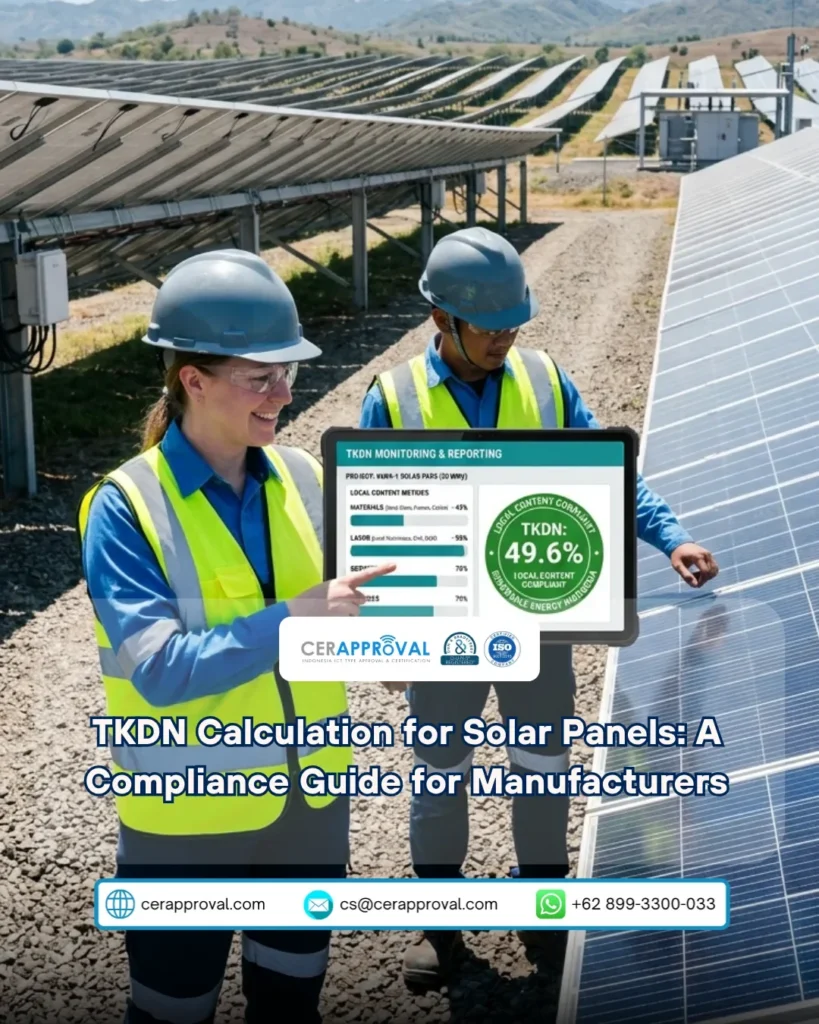
TKDN Calculation for Solar Panels helps manufacturers understand how Indonesia assesses domestic content in solar modules. For manufacturers, assemblers, and equipment suppliers, this knowledge helps them prepare for TKDN verification. Indonesia has introduced specific rules for measuring domestic content in industrial products. However, not every product follows the same calculation method. Solar modules have their own calculation framework, while the certification process follows the applicable general regulations. This guide explains the main calculation factors, their official weights, and the documents manufacturers should prepare. It also covers the steps involved in preparing for verification. Understanding TKDN Requirements for Solar Panels TKDN stands for Tingkat Komponen Dalam Negeri, or Domestic Component Level. It measures domestic content under Indonesia’s applicable regulations. The legal framework includes Law No. 3 of 2014 on Industry and Government Regulation No. 29 of 2018 on Industrial Empowerment. In addition, the Ministry of Industry (Kemenperin) issued Regulation No. 34 of 2024 to govern TKDN calculations for solar modules. Meanwhile, Regulation No. 35 of 2025 establishes a broader framework for TKDN and Company Benefit Weight (BMP) certification. Therefore, manufacturers should understand how the product calculation rules relate to the certification requirements. These two aspects serve different purposes. The first determines how manufacturers assess domestic content. The second governs the applicable certification process. Manufacturers should check both regulations before preparing an application. They should also review any relevant transitional provisions and current administrative requirements. Official references: Minister of Industry Regulation No. 34 of 2024 Minister of Industry Regulation No. 35 of 2025 Law No. 3 of 2014 on Industry TKDN Calculation for Solar Panels: Official Weighting Under Regulation No. 34 of 2024, solar module calculations cover three main production factors. Each factor has a specific weight in the overall assessment. Production factor Weight Direct materials 91% Direct labor 5% Factory overhead 4% Total 100% These weights apply to the solar module calculation framework. However, they do not represent the automatic TKDN value of a finished product. Instead, manufacturers must assess the relevant domestic content and apply the prescribed calculation method. The regulation also assigns specific weights to individual material components. Consequently, manufacturers should not calculate the final value by simply dividing local spending by total production costs. That approach does not capture all the requirements of the specific solar module methodology. 1. Direct Materials Direct materials account for 91% of the overall weighting. This category covers the materials and components identified in the applicable regulation. Examples include: Solar cells and their upstream production stages. Tempered glass. Photovoltaic junction boxes. Backsheets or bifacial materials. Frames. EVA film. Photovoltaic ribbon. Solar silicon. The regulation also distinguishes between stages in solar cell production. These stages include silica procurement, silicon production, ingot manufacturing, brick manufacturing, wafer production, blue cell production, and cell printing. Each relevant component has its own prescribed weight. For example, tempered glass has a weight of 12%, while frames have a weight of 9%. Photovoltaic junction boxes carry a weight of 8%. However, these figures do not automatically become the product’s TKDN percentage. Manufacturers must assess the domestic content of each relevant component according to the applicable criteria. For this reason, companies should keep clear records of component origins and manufacturing activities. These records help support the calculation during verification. 2. Direct Labor Direct labor accounts for 5% of the overall weighting. It relates to labor involved in the relevant manufacturing activities. Manufacturers should maintain employment and production records to support their assessment. For example, they can organize payroll records, employee assignments, and production reports. These documents help connect labor costs to the manufacturing process. However, companies must still follow the applicable rules when assessing domestic content. A consistent recordkeeping process also helps manufacturers identify missing information before submitting an application. 3. Factory Overhead Factory overhead accounts for 4% of the overall weighting. This category covers the relevant indirect factory costs considered under the regulation. Manufacturers should organize supporting accounting and production records. Depending on the applicable requirements, these records may cover utilities, maintenance, equipment, and other relevant factory expenses. However, companies should not automatically classify every expense incurred in Indonesia as domestic content. The prescribed calculation method determines how the relevant costs contribute to the assessment. How to Calculate TKDN Value for Solar Modules Manufacturers must apply the weighted calculation method established by the applicable regulation. In practice, they need to assess the relevant production factors and material components before applying their prescribed weights. The general concept can be expressed as follows: TKDN = Sum of the weighted domestic-content contributions under the applicable calculation method. This expression explains the principle behind the assessment. It does not replace the detailed formula and criteria in Regulation No. 34 of 2024 and its appendix. First, manufacturers identify the relevant production factors and components. Next, they assess domestic content according to the prescribed criteria. Finally, they apply the relevant weights to determine the calculated contribution. The direct materials category carries 91% of the overall weighting. Direct labor carries 5%, while factory overhead carries 4%. However, the weight of a component is not the same as its actual domestic-content contribution. The final result depends on the applicable assessment and supporting evidence. Why a Simple Cost Formula Is Not Enough A simple ratio of local expenditure to total production expenditure can help with internal financial analysis. Nevertheless, manufacturers should not present that ratio as the official solar module TKDN formula. The specific framework uses prescribed weights for production factors and material components. Therefore, a calculation based only on local purchasing costs may produce a different result from the official assessment. Manufacturers should use the official calculation format when preparing their documentation. They should also distinguish preliminary estimates from values established through the applicable verification process. Documents to Prepare for TKDN Verification Good documentation helps manufacturers support their calculations. Before applying, companies should organize records that match their product and the applicable certification requirements. Bill of Materials and Component Records Start with a Bill of Materials (BOM). This document should identify the relevant components, quantities, suppliers, and […]

TKDN

Step-by-Step Guide: How to Process TKDN Certification in Indonesia

TKDN certification in Indonesia is a vital requirement for companies aiming to enter public tenders. Furthermore, local content laws boost domestic manufacturing and local jobs. However, businesses must follow strict Ministry of Industry rules to pass the audit. Basically, TKDN measures local input in goods and services. Winning public sector contracts requires meeting these rules. Therefore, getting certified unlocks big business growth in Indonesia. 1. Strategic Benefits of TKDN Certification in Indonesia First, obtaining TKDN certification in Indonesia provides distinct market edges. Importers and local makers gain four primary advantages: Public Tender Access: Products with 40% combined score get legal priority in government procurement. Price Preference: High local content scores provide pricing advantages during public bid reviews. Regulatory Compliance: Audits ensure full alignment with Ministry of Industry rules. Brand Trust: Certification proves long-term commitment to local economic growth. 2. Prerequisites Before Filing Indeed, enterprises must meet basic legal needs before applying. Therefore, prepare these four main items first: Active local business license (NIB) and PT PMA status. Industrial Business License (IUI) linked to the SIINas portal. Active factory, assembly plant, or service site in Indonesia. Clean financial records detailing raw material costs and direct labor. 3. Step-by-Step TKDN Audit Workflow Securing your official certificate involves a clear, five-step process: First, set up your SIINas account: Register your business profile on the Ministry of Industry web portal. Next, run an internal assessment: Calculate local raw materials, local labor, and factory overhead costs. Then, hire an independent verifier: Appoint authorized test bodies like PT Sucofindo or PT Surveyor Indonesia. After that, complete the factory audit: Inspectors verify material invoices, payroll logs, and assembly lines on site. Finally, receive your certificate: The Ministry of Industry reviews final reports and issues the official TKDN paper. Streamline Compliance with Cerapproval Calculating local content metrics and handling government audits can feel hard. However, Cerapproval offers simple end-to-end consulting for your enterprise. Specifically, we guide initial gap reviews, document fixes, and final audit defense. Do you need fast help to get TKDN certification in Indonesia? Contact Cerapproval today for a free advice session to start your market entry! Get a free consultation for your certification. Download the complete guide to the KOMDIGI certification process. Schedule a meeting with the Cerapproval expert team today! Contact Us Today: 🌐 www.cerapproval.com 📧 gma@cerapproval.com 📱 WhatsApp: +62 899‑3300‑033

TKDN

How to Efficiently Process TKDN Certification for the Fertilizer Industry in Indonesia

The agricultural sector is one of the main backbones of Indonesia’s economy. As the primary support for this sector, the fertilizer industry plays a critical role. However, to effectively penetrate the domestic market—especially for government procurement through the e-Katalog system—fertilizer manufacturers must obtain the Tingkat Komponen Dalam Negeri (TKDN) or Local Content Requirement (LCR) certification. Is your company ready to comply with this regulation? Let’s delve into why Fertilizer TKDN Certification is vital and how to navigate the process smoothly. Why is Fertilizer TKDN Certification Mandatory? The Indonesian government is heavily enforcing the utilization of domestic products (P3DN program). According to current regulations, products with high TKDN scores receive a price preference and are highly prioritized in government tenders. For fertilizer manufacturers, holding a TKDN certificate unlocks massive strategic advantages: Assessment Components for Fertilizer TKDN Calculating the TKDN value for fertilizer products goes beyond the finished goods; it encompasses the entire manufacturing ecosystem: Key Takeaway: The minimum TKDN threshold generally required to safely secure government procurement contracts ranges from 25% to 40%, varying by the type of fertilizer (organic, NPK, bio-fertilizer, or chemical). Steps to Process TKDN Certification with Cerapproval Navigating the certification process independently can be time-consuming due to complex cost-accounting standards and rigorous documentation. This is where Cerapproval steps in as your strategic partner. Here is the structured process we provide: Partner with Cerapproval Today Do not let your competitors win lucrative government tenders just because of incomplete administrative compliance. With Cerapproval, your Fertilizer TKDN Certification process becomes faster, transparent, and legally secure. CTA (Call to Action): 🚀 Ready to Boost Your Fertilizer Sales in the Government Market? [Contact Cerapproval’s Experts Today] for a free consultation and kickstart your company’s TKDN Want your device certified quickly and accurately? Contact Cerapproval today for a free consultation and start your certification process! Contact Us Today:🌐 www.cerapproval.com📧 gma@cerapproval.com📱 WhatsApp: +62 899‑3300‑033

TKDN

What Devices Require TKDN Testing and How to Process It in Indonesia?

As Indonesia continues to strengthen domestic manufacturing and reduce dependence on imported technology, TKDN (Domestic Component Level / Tingkat Komponen Dalam Negeri) has become a critical requirement across multiple industries. For manufacturers, importers, distributors, and project vendors, understanding which devices require TKDN testing is essential for market access, government procurement eligibility, and regulatory compliance. In practice, many companies ask the same question: What types of devices are required to undergo TKDN testing, and how does the certification process work? This is especially relevant for telecom products, networking infrastructure, industrial electronics, and smart technology solutions entering the Indonesian market. In this article, Cerapproval explains the key device categories commonly subject to TKDN requirements and outlines the general process for obtaining TKDN certification in Indonesia. What Is TKDN Testing? TKDN refers to the percentage of domestic content used in a product, service, or a combination of both. In the context of hardware and electronic devices, TKDN assessment measures how much of the product’s value is contributed by local materials, local manufacturing, local assembly, local engineering, and supporting domestic services. TKDN testing or verification is often required to: For many businesses, TKDN is no longer optional it is a strategic compliance requirement. Types of Devices That Commonly Require TKDN Testing The exact requirement depends on sector-specific regulations, but the following device categories are among the most common: 1. Telecommunications Devices This is one of the most regulated sectors under TKDN-related frameworks in Indonesia. Common examples include: Telecommunications equipment used in public networks, operator infrastructure, or connected services often requires close alignment with Indonesian regulatory requirements, including TKDN and technical certification. 2. Network Infrastructure and Data Center Equipment As Indonesia expands its digital economy, network and data center systems are increasingly relevant in TKDN discussions, especially in large enterprise and public-sector projects. Examples include: For government and SOE projects, TKDN compliance for these devices can significantly affect procurement eligibility. 3. Industrial Electronic Devices Industrial automation and control systems may also fall under TKDN evaluation, depending on project scope and sector regulations. These include: 4. Energy, Smart Systems, and IoT Devices In sectors such as utilities, energy, and smart city deployment, TKDN may apply or be strongly preferred for products such as: 5. Devices Used in Government or SOE Projects Even if a product is not explicitly listed in a public regulation, it may still effectively require TKDN if it is intended for: In these cases, TKDN certification often becomes a decisive factor during vendor qualification. How to Process TKDN Testing and Certification The TKDN process may vary by product category, but the general workflow typically includes the following steps: 1. Product Classification The first step is to determine the correct classification of the device. This matters because each category may have: Correct classification at the beginning prevents costly delays later. 2. Prepare Technical and Commercial Documents A complete document package is essential. Commonly required documents include: Well-prepared documentation can significantly speed up the review process. 3. Domestic Content Analysis At this stage, the product is evaluated based on: This analysis determines the final TKDN percentage. 4. Verification and/or Testing by Authorized Bodies The product may then be reviewed by an authorized surveyor, verifier, or institution appointed under the applicable framework. Depending on the device, the process may involve: This is the formal stage where compliance claims are validated. 5. Issuance of TKDN Certificate Once the product meets the required criteria, the official TKDN certificate or equivalent compliance document is issued, confirming the product’s domestic content percentage. 6. Coordination with Other Certifications For many devices, TKDN is not the only approval required. It often needs to be aligned with: That is why companies often benefit from an integrated certification strategy. Why Work with Cerapproval? TKDN certification can become complex when businesses are unfamiliar with: Cerapproval supports businesses by helping them: Conclusion Devices that require TKDN testing commonly include telecommunications equipment, network infrastructure, industrial electronics, energy-related smart systems, and products intended for government or SOE procurement in Indonesia. Because the exact obligation may depend on sector regulations and procurement context, early assessment is crucial before launching or bidding with a product. If your company wants a smoother and faster path to TKDN testing and certification in Indonesia, partnering with an experienced certification agency is a smart move. Cerapproval is ready to support your TKDN testing, verification, and certification process with practical, compliant, and end-to-end assistance. Want your device certified quickly and accurately? Contact Cerapproval today for a free consultation and start your certification process! Contact Us Today:🌐www.cerapproval.com📧 gma@cerapproval.com📱 WhatsApp: +62 899‑3300‑033

Flag Counter
Scroll to Top